




Vapes & Pouches Kashrus for Pesach – an in-depth analysis
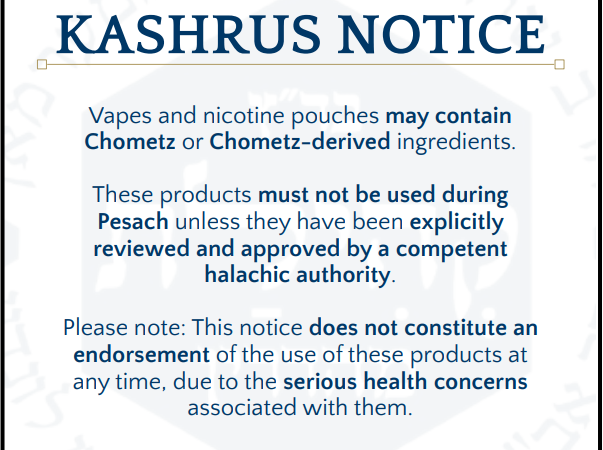
Chometz concerns: Kashrus of Vapes & Nic-Pouches
This article was written by Rabbi Y.M. Guttentag, KF’s Director of Certification & FedTech.
Introduction
In recent years, various nicotine devices have gained popularity. Medical experts strongly caution against these devices, particularly vapes, which have been proven to introduce dangerous toxins to lung tissue. The long-term health effects of all these devices remain unknown.
The introduction of these devices has given rise to new halachic and Kashrus questions which our Rabbonim now face. The volume of these shailas increases significantly over the Pesach period as people scrutinise their food and drink more closely. So, is there a Chometz issue?
Ahead of Pesach 2025, Kehillas Federation’s Rabbonim and Kashrus experts carried out a deep review of these devices, how they work and which ingredients are used.
Our Kashrus Department has previously been called upon by companies in Europe and Asia to certify their vapes. During these evaluations, KF was furnished with extensive information on the ingredients used in these products. Already well-equipped to provide insight into these devices and their Kashrus, a recent visit to a factory in Germany completed the picture.
Armed with critical information Rav SF Zimmerman, our Rov and Av Beis Din issued a definitive ruling stating that there are Chometz concerns associated with use of vapes and pouches and that members of the Kehilla should only use devices which have been researched and reviewed by a competent authority.
Who says vapes are a Chometz problem? What are the Chometz and Kashrus concerns involved in Vapes?
The liquid used in vapes – sometimes called the juice – is produced from a few basic ingredients which at first glance do not seem to contain obvious Chometz.
But as Kashrus experts, we know to look beyond the label. Let’s study each ingredient and assess their potential Chometz risk.
1. Glycerine. There are no Chometz risks associated with this ingredient. But there are substantive kashrus risks for round the year usage.
Glycerine is the backbone of all fat molecules (known collectively as triglycerides). You can take apart a fat molecule – whether animal fat (lard) or vegetable fat (eg sunflower oil) – through a relatively simple process called transesterification which involves heating the fat and adding methanol to it. The result will be a mixture of glycerine and FAME (short for fatty acid methyl ester). The two components in this mixture can then be separated and a clear, sticky and slightly sweet liquid glycerine results.
Used as a humectant (to preserve moisture) in the food industry, it is also a great solvent; and in the case of vapes, it’s a simple carrier for the flavours and nicotine liquid. No Pesach issues because it can’t be Chometz but it may well be treif.
2. Propylene glycol. Vapes rely on a solvent or carrier as a base on which to present the key ingredients flavours and nicotine. A widely used option is propylene glycol. Usually this is produced from simple and question free ingredients through petrochemical processes. But it can be produced from glycerine. Chometz risk is absent. Some year round Kashrus risk.
3. Flavours. The words natural flavourings or artificial flavourings are almost always present on retail food products. Whether in soft drinks, confectionary or snack foods.
But what do they mean? In Kashrus certification, flavour houses – as the Manufacturing facilities which produce these vital ingredients are known – are considered amongst the most complex of environments to operate and guarantee robust Kashrus. It is not uncommon to find as many as 5000 individual ingredients at use in these factories, where flavour chemists combine chemicals – mixing as many as 100 individual ingredients into one single flavour compound. The finished product at these factories will be flavour compounds which may be presented to industry as liquids in small bottles, drums or large barrels; used in small amounts they will provide the perfect strawberry taste or mint feel for your favorite candy or toothpaste.
Flavours can come in liquid form, they may be sprayed on to carrier powders or they may be dried in cavernous drying towers whose upward facing hot air circulation meets a fine atomised spray in its way down from the tower’s spray nozzles turning the fine mist into small powder particles. Flavours are incredibly complicated. When a Kashrus expert is asked “What could be wrong with them?”, he will respond “Do you know what is in them?”. Before concluding this aspect of the discussion it’s worth making mention of the fact that many flavours can be produced at their best by making an “extract”. Take vanilla pods and sit them for days or weeks in ethanol (alcohol) which can be sourced from Chometz and you produce highest quality vanilla essence. Its synthetic equivalent, produced by combining chemicals is a cheap copy and you’ll taste the difference. The chometz status of the natural version is easy to appreciate.
Summary: flavours can be treif and chometz. Flavours should be checked before assuming they are Kosher and Kosher lePesach.
4. Nicotine. This ingredient is the key reason why vapes have become popular. Its the addictive element which will make the users come back again and again. It’s also the reason why people have managed to move from traditional tobbaco products when they thought vaping was the safer option.
Industrial production can take a variety of routes. Extraction from tobacco leaves is one possible route which sees the nicotine isolated from the plant material. This can be achieved through solvent extraction, steam extraction or super-critical CO₂ extraction (a fascinating process which deserves its own article). Solvent extraction means a significant chometz risk as ethanol would be an effective solvent to use for this process. There is also a synthetic route for production of the nicotine liquid. At first glance, the feedstock chemicals for the synthetic process would seem to be Chometz-Free. But a recent visit by a Kashrus expert to a facility carrying out this process found ethanol used as a foundational building-block to one of the important chemicals used. Yet another chometz risk.
Conclusion: many of the ingredients of vapes carry significant Chometz risk. Even for year round use they are far from question free.
Vapes are inedible? I’ve never seen a dog eating the liquid?
To qualify for the prohibitions of Chometz, a product must be made from one of the 5 types of grain חמשת מיני דגן. But if it has deteriorated and is no longer edible neither to a human nor even to a dog then it loses its halachic status of a food and no longer qualifies as Chometz. See שלחן ערוך או”ח תמב.
Many have argued that the vape is inedible and should not quality as Chometz.
When challenged, some who make this claim will say “look, it’s poisonous” or – “try it you’ll see”.
Familiar with these ingredients from interacting with them in industry, we believe that this position is developed from a lack of understanding of food ingredients – how they are produced and how they are used.
Let’s go back to the flavour house. Many of the hundreds of ingredients in use at these factories are extremely strong and corrosive when presented in their raw state. Mix them together, and the finished flavour compound is dangerously powerful and even flammable and must be stored and handled with great care. But when the flavour compound is delivered to a candy manufacturer’s production line, use of just a small amount will deliver your favorite sticky candy; its flavour designed to mimic to perfection the strawberry and lemon, or even custard and cream.
Food ingredients are powerfully strong before dilution and one can’t consume them as is, but this does not render them a “non-food”.
There is halachic precedent for this. Horseradish – Chrayne. Take it alone when fresh and you hurt yourself. But the mitzva of Maror requires you to use this food item on Seder night.
The Gemoro :חולין נח refers to חלתית Chiltis – a vegetable which is so strong that it burns a hole in the digestive system of an animal which accidentally chances on it whilst munching in the field. Yet the Mishna :עבודה זרה לה relates that Chazal forbade this food item when purchased from a non-Jew due to concern that non Kosher equipment was used to cut and prepare it.
Acetic acid. Transported in huge road tankers sporting orange signs warning of hazardous contents. In its raw form, it is dangerously corrosive, but dilute down to 5% and we have Pesach vinegar.
Conclusion: We believe that all the ingredients in the vape are intrinsically edible; they just need some dilution or to be used in the relevant quantities and they are eminently palatable.
It is difficult to argue that vape juice is אינו ראוי לאכילת כלב.
I have read online that vapes are toxic. Why doesn’t that mean that they are not edible?
The sad fact is that as vaping has become popular, countless young children have been attracted to the sleekly-designed devices with their flashing lights and fashionable colour schemes. But it has been proven that there are high levels of toxins found in the bloodstream of those who vape. A careful review of the research indicates that these toxins aren’t present inside the glass reservoirs of the vape itself. Instead, they are formed after the liquid is heated and before it is ingested.
What is the halachic status of this now toxic mixture? Can we argue that it is now inedible? This argument itself would require proof with the burden on those who wish to argue that the liquid is now inedible. But even this argument would not work to permit the use on Pesach.
The Gemoro in Pesochim :כא discusses the status of Chometz which was burnt rendering it unfit to eat, and states that if it was burnt before the zman issur then the item loses its Chometz status and one may derive benefit from it over the course of Yom Tov. But if burnt after the zman issur it remains forbidden throughout Pesach.
Conclusion: It would be wrong to argue that the vape is inedible and therefore permitted on Pesach due to the toxins which are present. In reality the toxins only form during the use and the resultant vapour would remain ossur even if it may be inedible.
What is the difference between vapes and cigarettes?
Having described the sheer number of ingredients used in vapes and the significant associated Chometz risk, and explained how the ingredients are intrinsically edible, the reader will conclude that vapes are clearly different from traditional tobacco products whose leaves were brittle, dry and totally inedible.
But there are other important differences. Chief amongst them is that the vaping experience centres around a vaporous cloud in the mouth. Users report actually feeling moisture in the mouth. A simple scientific experient can be carried out by filling the mouth with vapour and then exhaling into a tissue; this will easily demonstrate that the vapour is in fact a real liquid when the tissue becomes wet.
This toxic combination of factors certainly sets vaping apart from smoking and sets up the arguments for it being halachically forbidden on Pesach.
Is vaping forbidden during the year?
Whilst ruling against the use of Chometz vapes on Pesach, the requirement for Kashrus of vapes during the year remains unaddressed in Rav Zimmerman’s recent psak. We would suggest that one consult with their own Rov for a firm ruling on this topic.
But Kehillas Federation’s ShailaText position has long been to suggest that due to the shailas involved one refrain from use of non-approved vape products even during the year and not only during Pesach.
The reason for the difference between year round use and Chometz use?
Chometz must not be eaten on Pesach; additionally one must not derive benefit from Chometz. It is possible that vaping does not qualify as achila but it certainly qualifies as hano’oh.
But there are some arguments that vaping is really different from smoking and that it would qualify as achila.
Although we won’t explore this topic in depth, it is worth refering the reader to the Psak of Magen Avrohom תס”ז סק”י who addressed the permissibility of traditional tobacco on Pesach and noted that it was common for the leaves to be soaked in beer when they are processed. He therefore ruled that tobacco must be laid aside over Pesach. This psak is quoted directly by Mishna Berura who seems to pasken unequivocally that if it is indeed the case that the leaves are soaked in beer then the tobacco prodcuts would be forbidden on Pesach.
The exact rationale behind Magen Avrohom’s psak is debated by subsequent Poskim. Many take issue with his ruling given that once soaked into the inedible tobbaco leaves, the Chometz beer is no longer edible.
Magen Avrohom also commented in Hilchos Brochos with a suggestion that when smoking a person should be required to make a brocho. This suggestion did not make it to halachic consensus as Kesav Sofer wrote in a Teshuva.
Nonetheless, it seems reasonable to suggest that the acharonim who argue with Magen Avrohom in Hilchos Pesach and do not accept his view that smoke inhalation would be considered similar to eating, may only have argued against inhalation of a dry smoke.
Would these same acharonim agree that liquid vapour differs from smoke and if it resulted from a forbidden non-kosher substance then it would be forbidden to inhale the non-Kosher vapour?
If that were the case then even during the year drinking the vapour would be forbidden if the ingredients were treif.
What are pouches and what is their halachic status?
The small sachets of product seem to be the newest kid on the block but they present a more significant kashrus challenge than the vape itself.
Placed between the lip and the upper gum these flavoured products contain many of the same ingredients and vapes but they are packaged up in cellulose an ingredient which is often used in the food industry as a thickener. As the pouch becomes wet in the mouth, it gives off a constant flow of nicotine which is absorbed into blood stream through the gum. Users describe a tingly and mild burning sensation as the nicotine is abosrbed. Packed into the product is some flavour and sweetener to provide a sweet and pleasant experience.
Even the cellulose aspect carries some risk as it can be produced from oat husks. And the pouch certainly presents as an inherently more serious shaila than the vape due to its use of sweeteners which are a well known Chometz risk.
Our conclusion – Chometz Concern
Our Kehillos are accustomed to conducting their Pesach food-purchase with diligent care and attention. We scrutinise every hechsher to check if it meets our standards.
Matching that vigilance when considering use of tobbaco products would be the correct approach due to the serious shailas involved.
In ruling that chometz-containing vapes and pouches are forbidden on Pesach, Rav Zimmerman takes the view that the liquid is edible and using the device constitutes a question of Issur Hano’oh.
On Pesach, when halocho forbids both standard eating (achila) and hano’oh (deriving benefit), many of the potential arguments against this ruling fall away. Rav Zimmerman maintains that even those who permit the use cigarettes on Pesach and year round would view the use of vapes more stringently and would not permit them.
Closing comment – ונשמרתם מאוד לנפשותיכם
The author would like to close with a parting message to members of the Kehilla to take some time to review the dire health warnings issued by medical professionals and to consider the serious risks of ill health associated with use of any nicotine products.